
Alfarim
Parakite and paragliding groundhandling site
Alfarim, in the municipality of Sesimbra, is one of the sites used for Parakite and paragliding groundhandling and for the practical sessions of the courses available.
Unlike the coastal sites used for soaring, this place is mostly associated with ground training, making use of the wide stretches of sand and small dunes to work on wing control and build technique.
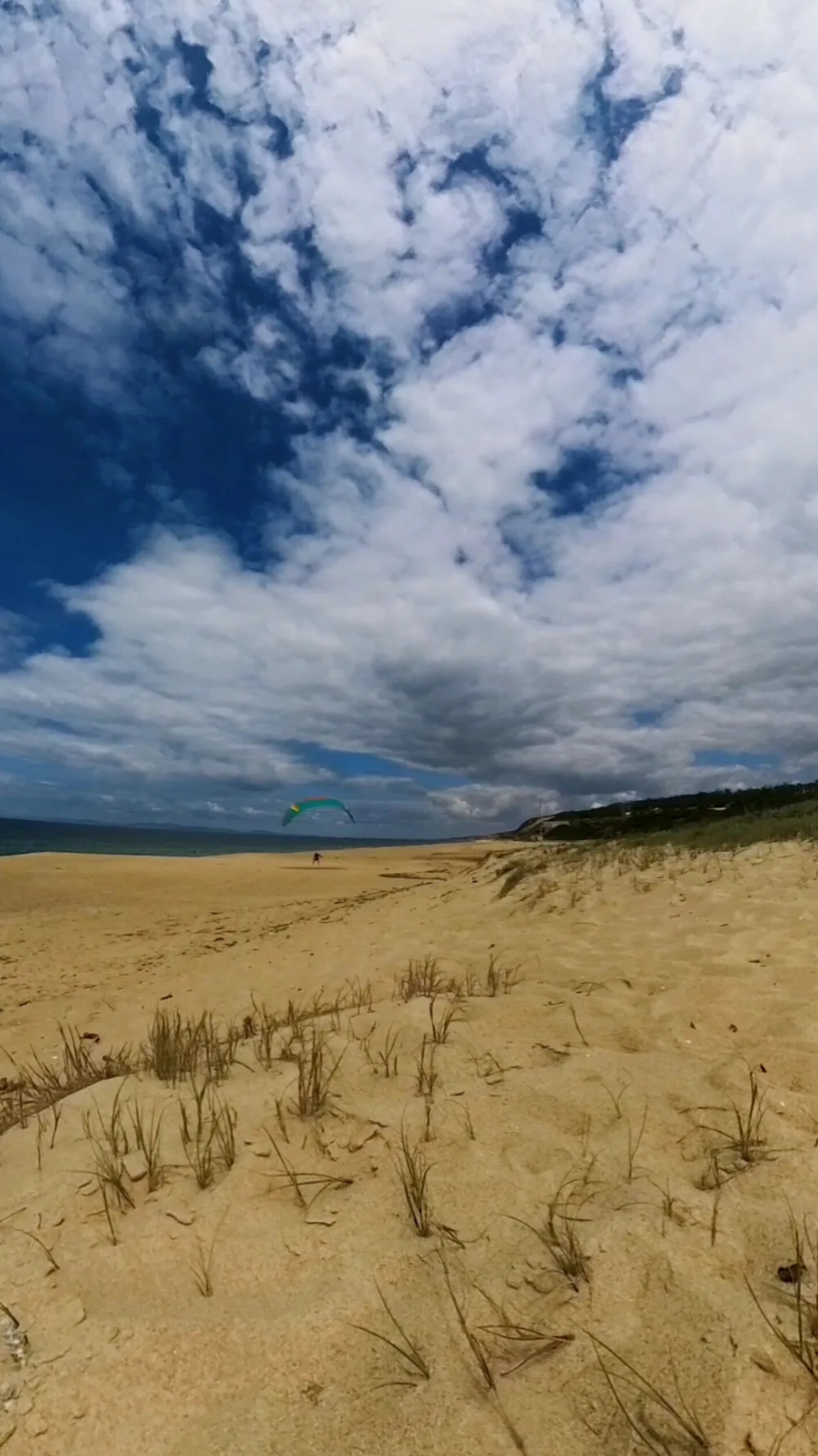
Groundhandling
Groundhandling is about working on wing control on the ground, without flying being the aim of the session.
At Alfarim, the combination of beach, sand and small dunes allows for different exercises, repeating movements and progressively building coordination, positioning and wing control.
The exercises can be adapted to the pilot’s level, to the equipment being used and to the goals of each session.
Parakite and paragliding
Alfarim is used for ground training with both Parakite and paraglider.
Although there are principles of wing control that are common to both, the different types of equipment, sizes and characteristics of each wing shape how it behaves.
Training therefore has to be adapted to the pilot and to the equipment being used.
Alfarim in the courses
Alfarim is one of the sites used for the practical sessions of the courses available.
The choice of site for each session depends on the conditions at the time, on the level of the participants, on the equipment being used and on the goals of the training.
Over the course of a programme different sites may be used, so that the conditions and the terrain can be matched to the exercise at hand.
Conditions for groundhandling
Unlike a soaring site, there is no specific wind direction required to use Alfarim for groundhandling.
What matters is assessing the conditions at the time and judging whether they suit the exercise, the pilot and the equipment being used.
Wind strength, gusts and the quality of the flow have to be considered together with the model and size of the wing, the pilot’s experience and the type of exercise.
For that reason we also give no minimum or maximum wind figures that would apply to every situation.
The training area
Training takes place on the sand and on the small dunes, choosing whichever area best suits the conditions and the exercises planned.
The beach offers wide areas for working the wing on the ground, while the small variations in the terrain can be used for specific exercises as the training progresses.
The area used is about a 5-minute walk from the parking.
Learning through repetition
Ground training makes it possible to repeat movements and to build up the relationship between pilot and wing.
The aim is not only to manage a given movement, but to understand what is happening, to do it correctly and to repeat it until the control becomes progressively more natural.
For someone who is learning, this practice helps build the foundations for what comes later. For experienced pilots, it is a way to keep refining control, precision and the wing’s response.
A shared space
Alfarim is also an area used by other people, especially during the busier periods on the beach.
Laying out wings and running exercises has to take into account the presence of other users and the space available.
It matters to keep enough margin to do the exercises without getting in the way of those using the beach.
Respect for the place
The beach and the small dunes are part of a coastal environment that has to be looked after.
Groundhandling should aim to keep its impact on the place to a minimum, to respect the existing access paths and to avoid damaging the dune vegetation.
Whenever there is suitable space on the sand, those areas should be preferred, leaving the small dunes for exercises where the terrain has a specific role.
Respecting the place helps keep it available to everyone.
Reference information
- Location
- Alfarim, Sesimbra, Portugal
- Main use
- groundhandling / ground training
- Disciplines
- Parakite and paragliding
- Activity
- technical training and instruction
- Terrain used
- sand and small dunes
- Wind direction
- no specific direction required for groundhandling
- Use in the courses
- yes, according to the conditions and the goals of the session
- Distance from the parking
- about a 5-minute walk
- Parking
- easy, and seasonal
- Flying
- not the purpose of this training site