

Parakite guide
What is a Parakite?
A Parakite is a flexible wing characterised above all by its control system, which lets the pilot significantly change the wing’s configuration - including its longitudinal geometry and its incidence - in flight. That range of control directly influences speed, pitch, trajectory and energy management.
- Speed
- pitch
- trajectory
- energy
A Parakite is not defined on its own by size, by speed, by the use of a reflex profile or by any particular mechanical solution. What is fundamental is the way the control system allows the wing’s configuration to be changed in flight.
The principle, not the mechanism
What sets a Parakite apart?
The main difference is the control system. On a Parakite, brakes, risers and line groups work as one: the pilot’s action can change the relations between those elements and, with them, the configuration of the wing.
Put simply, the path is always the same: pilot → brakes → risers and lines → wing configuration → speed, pitch, trajectory and energy.
The distinguishing characteristic lies in the architecture of the risers and the brakes, and in the range of control that system gives the pilot.
The control principle is what sets the category apart; the mechanical implementation can vary from design to design.
The brakes are more than brakes
How is a Parakite controlled?
The brakes on a Parakite do more than slow the wing down. By raising or lowering the hands progressively, the pilot acts on a system that can change the relation between different line groups and risers, moving through different wing configurations in flight.
The exact behaviour, the range of the movement and the way that change is achieved depend on how each Parakite is designed.
That is why understanding a Parakite means thinking of the brakes not as brakes alone, but as part of a system that controls the configuration of the wing.
From input to flight
How does a Parakite work?
The pilot’s input acts on the system of lines and risers. The relation between the different elements changes, the configuration of the wing changes, and that change influences how it behaves in flight - the brakes are not acting on the trailing edge alone.
This relation is also the basis for understanding one of the central features of flying a Parakite: energy management.
Bringing the hands progressively down changes the configuration and speed drops. The energy stored as speed can then be used to change the trajectory, reduce the descent and, in certain situations, temporarily gain height.
The path of the input
Size, wing loading, speed, control
Is a Parakite just a small paraglider?
Size on its own does not define a Parakite. Parakites come in different areas, and those areas can overlap with paragliders, miniwings or speedwings.
What sets them apart is still the control system: the architecture behind it and the range of configuration change it gives the pilot. A small paraglider is therefore still not necessarily a Parakite.
The wing loading a wing is flown at influences how it behaves, but it does not define the category either - and choosing a size is a separate subject, which this page does not cover: see How to choose a Parakite.
The same physics, a different command
Parakite vs paraglider: what really changes?
Parakites and paragliders are flexible wings and share many aerodynamic principles. What changes is how the pilot controls the wing’s configuration.
On a conventional paraglider the brakes act mainly by deforming the trailing edge, and changes of speed and incidence are normally made separately - through the speed bar or, on certain wings, through trimmers. Some modern paragliders also allow pitch control through the rear risers or associated systems - it would be wrong to describe them as wings controlled by the brakes alone.
On a Parakite, that wider change of configuration is built into the very command the pilot uses. Raising or lowering the hands is not simply “less brake” or “more brake”: it is moving through the different configurations the system provides for.
It is that integration which makes it important to understand the relation between configuration, speed, trajectory and energy.
Height, speed, trajectory
Energy management
Parakite flying is energy management.
In flight the wing mainly holds energy associated with its height and its speed. By changing configuration and trajectory the pilot continuously manages the relation between these two forms of energy.
On a descending trajectory, height lost can be converted into speed gained. That speed is energy which can be conserved and used later. When the pilot progressively increases the input, the configuration and the pitch change - and that speed can then be used to alter the trajectory, reduce the descent or, when there is enough energy, fly an ascending trajectory and temporarily gain height.
The conversion is never perfect. Drag continuously dissipates part of the energy, so every manoeuvre has losses. How efficiently a wing conserves speed and lets it be reused depends on the design, the configuration, the trajectory and the pilot’s action.
What changes for the pilot
What is it like to fly a Parakite?
Flying a Parakite is not mainly about choosing a direction: it is about continuously managing the wing’s configuration. The pilot’s attention is no longer split between brake and direction - it takes in the four axes at once (speed, pitch, trajectory and energy), which change together and change with what the pilot does with hands and body.
In the adaptation of paraglider pilots there are three habits that change consistently, and they describe the difference better than anything else:
- the response is no longer sought mainly through the brakes: it comes to involve the body, legs, chest, shoulders and risers, with the brakes used more progressively and consciously;
- the eyes no longer follow the wing but stay on the low side, feeling the wing through the body and the risers, without over-reacting to what is seen;
- the correction no longer happens once the wing is already out of line: the speed of the inflation and the closeness to the ground demand anticipation - preparing the position and correcting early.
In Happy Soaring’s own experience, the feedback that arrives through the wing, the risers and the body is information for the pilot. Different Parakites can transmit or filter that information in different ways, so the feel and the level of feedback should not be generalised to the whole category.
The relation between speed, trajectory, height and energy is the subject of the previous section, and it is what underpins all of this.
What the wing allows and how you fly it
Can I fly calmly with a Parakite?
Yes. A Parakite does not force the pilot to be constantly diving, hugging the terrain or manoeuvring. That is a chosen flying style, not a requirement of the wing: what the control system makes possible and what the pilot does with it are two different things.
Coastal soaring is the most direct example. When the wind meets the cliff or the relief of the dunes it creates dynamic lift, and the flight can follow that relief. The spot pages document, for instance, flights from Fonte da Telha north towards Costa da Caparica, south to the northern end of Lagoa de Albufeira, and from Meco south towards Praia das Bicas, whenever conditions allow the flight to be extended.
Speed, trajectory and energy can be managed in different ways depending on the flight the pilot has in mind. The range available is the same; what changes is what is done with it.
What decides how a flight goes are the conditions and the pilot, not the category of the wing. A calm flight still requires assessing the conditions as they are at the time.
Where these wings fly
What a Parakite is for
These wings are flown at coastal sites, where wind meeting a cliff or the relief of the dunes creates dynamic lift, and on stretches of sand, for ground training. A control system exists to be used somewhere.
They are two kinds of place with different purposes. A cliff or dune site allows coastal soaring along the relief, when the direction, the strength and the quality of the wind are suitable. A stretch of sand allows the pilot to work on wing control on the ground, without flying being the objective of the session.
We do not give a minimum or maximum wind figure for any of these sites, because there is no single figure that can be applied safely to every pilot and every wing. What counts is assessing the conditions as they are at the time.
The sites we use
Capabilities, not advantages
What does a Parakite let you do?
A Parakite lets the pilot manage speed, trajectory, height and energy through its control system. These are capabilities, and what is done with them depends on the pilot, the design of the wing and the conditions. The useful question is not what a Parakite has that is best, but what its control system lets the pilot do.
The range of the control system is what makes this possible, and it varies from design to design: how far the configuration can be changed in flight is a feature of each Parakite, not of the category.
None of these capabilities is an advantage in the abstract. A system with more range gives more to manage - and more to understand.
Purpose and possibility
Can I fly a Parakite in thermals?
Parakites were not designed with thermal flying as their main purpose.
A Parakite can find and use rising air during a flight. That is not the same as being a wing dedicated to thermal or cross-country flying: it is not what these wings were designed for, and the purpose they exist for is the one described in “What a Parakite is for”.
The distinction matters both ways. Not designed for thermals does not mean it cannot fly in a thermal; it means it was not designed for that to be the aim of the flight. On thermal performance this page makes no claims.
Not a question of category
Is a Parakite safer than a paraglider?
The question has no answer by category. It is not that a Parakite is safer than a paraglider, nor the other way round: what weighs are the factors of each flight.
A reflex profile can contribute to certain stability characteristics, but it does not prevent collapses and does not replace sound piloting. The subject has its own section further down this page.
There is no universal wind figure that can be applied in the same way to every pilot, every wing, every site and every condition. What counts is the assessment made on site, at the time of the flight - which is why the spot pages describe the directions used at each site but give no figures.
It depends where you start from
Is a Parakite hard to fly?
It depends where you start from. The more useful question is another one: what has to be adapted.
You move to the next step when the previous one is consolidated, not when the calendar says so. Two pilots with the same previous experience can take very different times, and neither of them is behind.
The method Happy Soaring uses to work on this adaptation - understand the wing, prepare the body, manage the energy - is called Pilot2Wing, and it has its own page.
From the ground to the air
How do you learn to fly a Parakite?
Learning is progressive and starts on the ground. Before flying, the pilot learns to control the wing on land: how the brakes, the body, the legs and hips, the harness and the risers work together, and what that does to speed, pitch, trajectory and energy. Flying comes only once that control is solid.
In Happy Soaring’s approach, Pilot2Wing, the work starts with the body (body first): feeling the wing through the body and the risers, looking to the low side, correcting early instead of reacting late, and not fighting the wing.
Happy Soaring’s training is for paraglider pilots and is given by the Coaches Pilot2Wing. If you already fly a paraglider and want to make this move, see how the Parakite course works.
The first contact with the wing
How is a Parakite inflated?
The inflation is the moment when the wing stops being fabric on the ground and becomes a surface that carries load. That moment can generate a lot of energy in very little time, and it happens close to the ground - which leaves little margin to correct afterwards.
That is why the inflation is not resolved by reacting: it is resolved by anticipating. Preparing the position before the wing starts to rise, following what it does and correcting early counts for more than correcting a lot.
The body and the risers are part of the control from the outset. It is not only a brake movement: the position of the body and the way the risers are worked are part of controlling the rise and the alignment of the wing.
And that is also why work on the ground is fundamental. It is not a warm-up: it is where the relationship between pilot and wing is consolidated, with the wing responding and the pilot correcting, without being in the air.
Brakes, risers and lines
What the risers do
The risers are the mechanical link between the wing’s different line groups and the pilot’s attachment points. On a Parakite they can also play an active part in the control system.
When the pilot works the brakes, the system can change the relative position of the different line groups in a coordinated way: some become relatively shorter or longer than others. That changes how different areas of the wing sit along the chord.
The risers do not control the wing on their own. They are part of an integrated system made of brakes, risers, lines and the geometry of the wing itself.
Correct behaviour also depends on the relative length of the lines and on the trim. Because each riser influences whole groups of lines, a small difference does not stay local. Trim is part of the wing’s geometry, and that is where why it matters is explained.
Four concepts that are not synonyms
Geometry, incidence and pitch
On Parakites the incidence is not necessarily fixed. Working the brakes can progressively change the geometry of risers and lines and, with it, the wing’s incidence in flight. Broadly, a more accelerated configuration tends to mean lower geometric incidence; increasing the input tends to raise incidence and reduce speed. The exact behaviour depends on how the control system is designed.
These concepts are related but not the same. Even if the wing’s geometric configuration did not change, the angle of attack could still vary because of a gust, a change of trajectory, a manoeuvre or the movement of the wing itself.
Nor is pitch determined by the pilot alone: it depends on inertia, speed, trajectory, pendular movement, gusts and the aerodynamic stability of the profile.
What is trimming for?
Trimming defines the reference configuration the wing flies from. It is the length relation between the different line groups that sets that configuration: where each area of the wing sits along the chord, and what the brakes are able to change. Trim is part of this geometry.
Small relative changes in line length can shift that reference configuration and alter symmetry, brake authority and reflex behaviour.
And there is a difference between designed geometry and geometry in service: wear, knots, repairs or asymmetries can change the relation between line groups even when the wing looks normal.
What hands up means
Hands up means progressively raising the brakes and reducing the input the pilot applies. It does not mean letting go of the brakes.
In many current systems this movement lets the riser geometry move to a more accelerated configuration: geometric incidence tends to decrease, speed increases, the wing tends to move forward in pitch and the trajectory can become more descending. And it is not just removing the deformation of the trailing edge - the same movement can drive coordinated changes between different line groups.
The Happy Soaring approach
Do I need a harness specific to Parakite?
Yes: in our approach, a split-leg harness is necessary.
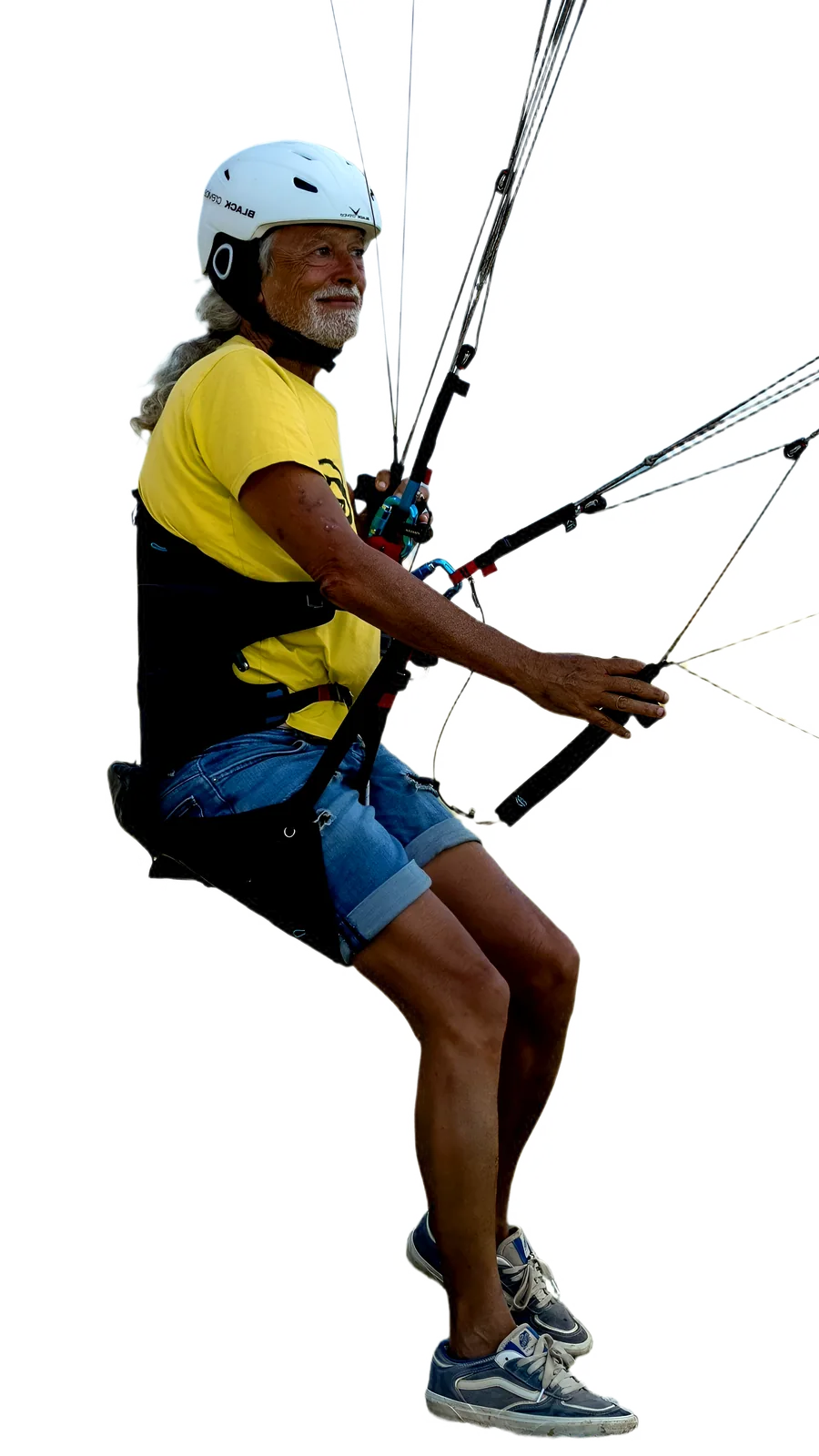
- Suspension points this is where the wing connects to the harness
- Harness connects the pilot to the suspension points and takes part in how load changes reach the system
- Controls act directly on the wing, at the same time as the body
- Hips takes part in how load is distributed in the harness
- Leg straps independent, one per leg
- Legs each leg’s position changes how the load is distributed
This is a technical and methodological position of Happy Soaring, and it is how we work at Pilot2Wing. It is not a standard of the discipline nor a requirement of Parakite manufacturers: we have no documentation stating that, and we do not invent it.
The reason lies in how we work on body control. In a split-leg harness, the legs can work more independently, and the position of the legs and hips influences how load is distributed - which is what reaches the wing through the harness and the risers.
The harness is part of the pilot–wing system. Body, harness and controls work together, and none of these parts works in isolation.
Anyone coming from paragliding brings a body reference formed in their usual harness, and may have to adapt it.
What is seen and what is not
Does a Parakite need inspection?
Yes - and it is worth distinguishing the pilot’s regular check from technical inspection.
A wing in service can stop corresponding exactly to the designed geometry. Use, wear, knots, repairs or asymmetries can change relations between components even when everything looks normal.
The difference between the two is not one of care, it is one of reach. One finds what is in plain sight; the other assesses relations between components that can change without any visible sign.
It is the same reason why trim matters: a wing can look intact and no longer be in the geometry it was designed with. Checking is not distrusting the equipment - it is knowing what condition it is in.
Part of the system
Reflex
Reflex is part of the system, not the definition.
Reflex is a feature of the aerofoil geometry: the rear part of the profile carries a curvature that modifies the wing’s pitching moment. On a wing with no horizontal stabiliser, this geometry can contribute to longitudinal stability.
On Parakites the reflex profile matters most in more accelerated configurations, where the wing tends to fly with lower geometric incidence and higher speed. In that condition it can help stabilise pitch behaviour and increase resistance to disturbances and to certain deformations.
The effect does not work in isolation. It depends on the profile design, internal pressure, sail tension, line and riser geometry, trim, loading and speed. Because the control system changes the wing’s geometry, the reflex effect available can vary with brake position - which is why small trim changes, knots, asymmetries or interference can alter the behaviour expected of the profile.
Where the boundaries are
Parakite, paraglider, speedwing and miniwing
These categories share basic principles: a flexible wing pressurised by the air, lines, risers and brakes. What separates them is above all the architecture of the control system and the way the wing’s configuration is changed in flight.
| Category | How it is controlled | On a Parakite |
|---|---|---|
| Paraglider | On a conventional paraglider the hand brakes act mainly on the trailing edge, allowing the pilot to steer, slow down and control the wing. Incidence and speed can also be changed through separate systems such as the speed bar, and some modern paragliders allow pitch control through the rear risers - it would be wrong to say they are controlled by the brakes alone. | On a Parakite, changing the configuration is integrated far more directly into the main brakes. That creates a different flying logic: moving progressively between faster and slower configurations through the brakes themselves. |
| Speedwing | On a speedwing, directional control is normally through the brakes and, in some systems, also through the rear risers. Speed and glide angle can be adjusted with trimmers or other systems specific to the design. | On a Parakite, the movement of the hands can progressively change the relation between line groups and, with it, the longitudinal configuration and incidence - letting the pilot manage a wide range of speed, pitch, trajectory and energy directly through the brakes. |
| Miniwing | The term miniwing is used broadly for wings derived from paraglider flying logic. In a conventional architecture the brakes act mainly on the trailing edge; where trimmers exist, they separately change speed, incidence and glide. | On a Parakite, changing the configuration is the job of the main brakes themselves: the interaction between brakes, lines and riser geometry progressively modifies the longitudinal configuration and the incidence. Some designs bring solutions from the two families closer - the distinction is still drawn by the architecture of the control system. |
One category, many designs
The implementation can vary
There is no single architecture that represents every Parakite.
Different Parakites can have different geometries, riser systems, mechanical ratios, profiles and control solutions. That is why no feature of one particular design should be read as a feature of the whole category.
What can vary between designs
The Parakites in the Flow Paragliders range
Frequently asked questions
What characterises a Parakite?
Above all the control system, which lets the pilot significantly change the wing’s configuration in flight - including its longitudinal geometry and its incidence. It is not size, speed, a reflex profile or any particular mechanical solution that defines it: it is the way the brakes change the configuration.
How does a Parakite work?
The pilot’s input acts on the lines and risers, not on the trailing edge alone. The relation between the line groups changes, the wing’s configuration changes, and with it speed, pitch, trajectory and energy. That chain is what puts energy management at the centre of flying a Parakite.
What do the risers do?
They connect the line groups to the pilot and, on a Parakite, can be an active part of the control system: they turn the input into coordinated changes between line groups, changing the wing’s configuration.
What does hands up mean?
Progressively raising the brakes and reducing the input. It is not letting go of the brakes, it does not necessarily mean best glide, and it is not simply “reducing the angle of attack”.
How does reflex work?
It is a profile geometry whose rear section modifies the wing’s pitching moment. On a wing with no horizontal stabiliser it can contribute to longitudinal stability, especially in accelerated configurations.
Does reflex prevent a collapse?
No. It increases the stability margin in certain configurations, but turbulence, low internal pressure, deformations, trim problems or inadequate inputs can still cause a loss of stability.
What is the difference between incidence and angle of attack?
Incidence describes how the wing is geometrically configured by the riser and line system. Angle of attack is the angle between the chord of the profile and the relative airflow at that instant.
What is the difference between a Parakite and a paraglider?
Both are flexible wings and share the same aerodynamics; what changes is how the configuration is controlled. On a conventional paraglider the brakes act mainly on the trailing edge, and speed and incidence change separately, through the speed bar or trimmers - although some modern paragliders allow pitch control through the rear risers. On a Parakite, that change is built into the brakes themselves.
Can a Parakite be used for speedflying?
Yes. Speedflying is a discipline, not a wing category, and there are Parakites designed specifically for that kind of flying.
Written by Paulo Pereira · Happy Soaring · Last reviewed: September 16, 2026